Introduction
For small business owners, efficiency and innovation are key to staying competitive. You might already be familiar with AI in the form of voice assistants or basic chatbots. However, a new generation of artificial intelligence is emerging: AI agents. These aren’t just tools that react to your commands; they are proactive, intelligent software systems designed to perceive their environment, make decisions, and execute complex tasks with minimal human oversight. This article will demystify what AI agents are, explaining their core capabilities and illustrating how they can be deployed to transform your business, offering a powerful leap in automation and operational effectiveness.
Chapter 1: Defining AI Agents: Autonomy, Proactivity, and Core Functions
Traditional AI tools often act as mere assistants, waiting for your specific instructions, much like asking Siri for the weather. AI agents, however, operate on a different level. They are autonomous software systems engineered to perceive their environment, reason about predetermined goals, formulate multi-step plans, and then execute tasks proactively, all with minimal direct human intervention. Think of them not just as responders, but as intelligent problem-solvers capable of initiating and managing complex workflows. This inherent proactivity is a game-changer for small businesses looking to automate beyond simple, repetitive tasks.
The operational genius of AI agents is rooted in three core functions:
- Perception: This is the agent’s ability to “see” and “hear” its digital environment. For your business, this could mean gathering data from spreadsheets, monitoring customer interactions on your website, analyzing market trends through APIs, or processing incoming emails. It’s about collecting the necessary information to understand the current situation and identify opportunities or challenges.
- Reasoning/Decision-Making: Once data is perceived, the agent processes it to understand context and plan actions. This involves sophisticated problem-solving – an agent might evaluate various solutions for a logistical issue, prioritize customer service requests, or identify bottlenecks in your sales pipeline. Recent advancements in generative AI and large language models (LLMs) have significantly boosted agents’ ability to reason, allowing them to handle complex, unstructured scenarios that were previously impossible for automated systems. This empowers them to devise intelligent strategies, rather than just follow rigid scripts.
- Action: This is where the agent puts its plans into motion. Actions can range from updating a database, sending personalized follow-up emails, automating inventory reorders, or even interacting with other software systems (like your CRM or accounting platform) to execute a multi-step process. The goal is to achieve specific objectives efficiently, freeing up your team to focus on strategic initiatives and customer relationships. For more insights into how such systems are developed, you can visit aidevelopers.in. Understanding these core functions helps small business owners grasp the potential for true operational transformation.
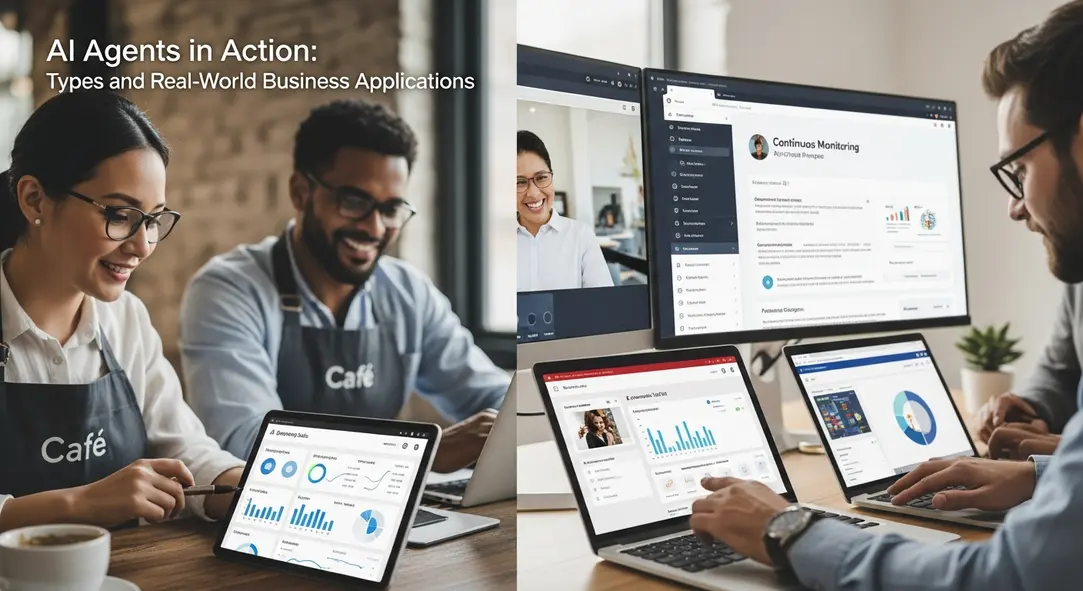
Chapter 2: AI Agents in Action: Types and Real-World Business Applications
The versatility of AI agents allows them to be categorized based on their primary function, offering tailored solutions for small businesses.
- Aggregation agents excel at synthesizing diverse data points, such as compiling customer feedback from multiple channels into a single, actionable report.
- Action agents are designed to execute specific tasks, like automatically processing new leads from your website or managing your social media posting schedule.
- Ambient agents work quietly in the background, continuously monitoring systems for anomalies or opportunities, such as flagging unusual transaction patterns or tracking competitor pricing.
Crucially, these agents can even work together within multi-agent systems, coordinating efforts to achieve broader business objectives. For instance, an aggregation agent might gather market data, an action agent might adjust pricing based on that data, and an ambient agent might monitor the sales impact, all in concert. This collaborative power, often referred to as agentic AI, allows for sophisticated automation across multiple tools and teams, streamlining complex enterprise workflows.
The applications of AI agents for small businesses are diverse and impactful:
- Data Validation & Compliance: Agents can automatically check the accuracy and completeness of customer data, ensuring compliance with regulations and improving data quality.
- IT Automation: From managing software updates to monitoring server health, AI agents can streamline IT operations, reducing the burden on your limited IT resources.
- Customer Service: Advanced virtual assistants can handle complex customer queries, provide personalized recommendations, and even troubleshoot issues autonomously, enhancing customer satisfaction and freeing up human agents.
- Marketing & Sales: Agents can analyze customer behavior to personalize marketing campaigns, identify high-potential leads, and automate follow-up communications, boosting conversion rates.
- Inventory Management: By continuously monitoring stock levels and sales trends, agents can automate reordering, minimize waste, and optimize supply chains.
A key advantage for dynamic environments, such as testing new products or adapting to market changes, is the ability of AI agents to maintain an internal state. This “memory” allows them to learn from past interactions and adapt their behavior, contributing significantly to their reliability and consistent performance over time. Ready to explore how these solutions can be tailored for your business? Don’t hesitate to contact us at aidevelopers.in. To understand our commitment to your privacy, please review our privacy policy. Learn more about our expertise on our about us page.
Final thoughts
AI agents represent a powerful evolution in business automation, moving beyond simple reactive tools to become proactive, intelligent problem-solvers. By understanding their core functions—perception, reasoning, and action—and recognizing their diverse types and applications, small business owners can unlock unprecedented levels of efficiency, accuracy, and innovation. Embracing AI agents means not just automating tasks, but strategically enhancing your business capabilities, allowing you to streamline operations, optimize customer interactions, and achieve sustainable growth in an increasingly competitive landscape.
Ready to elevate your business with cutting-edge automation? Contact aidevelopers.in Agency today and let our expert team guide you to streamlined success with AI-driven solutions!
About us
This article has been reviewed and refined by Yaswanth to ensure accuracy, clarity, and practical value for readers. Yaswanth is an experienced automation developer with over 7 years of hands-on expertise designing, building, and optimizing automation workflows across various platforms and industries. His work focuses on simplifying complex processes, improving efficiency, and helping teams leverage technology more effectively.